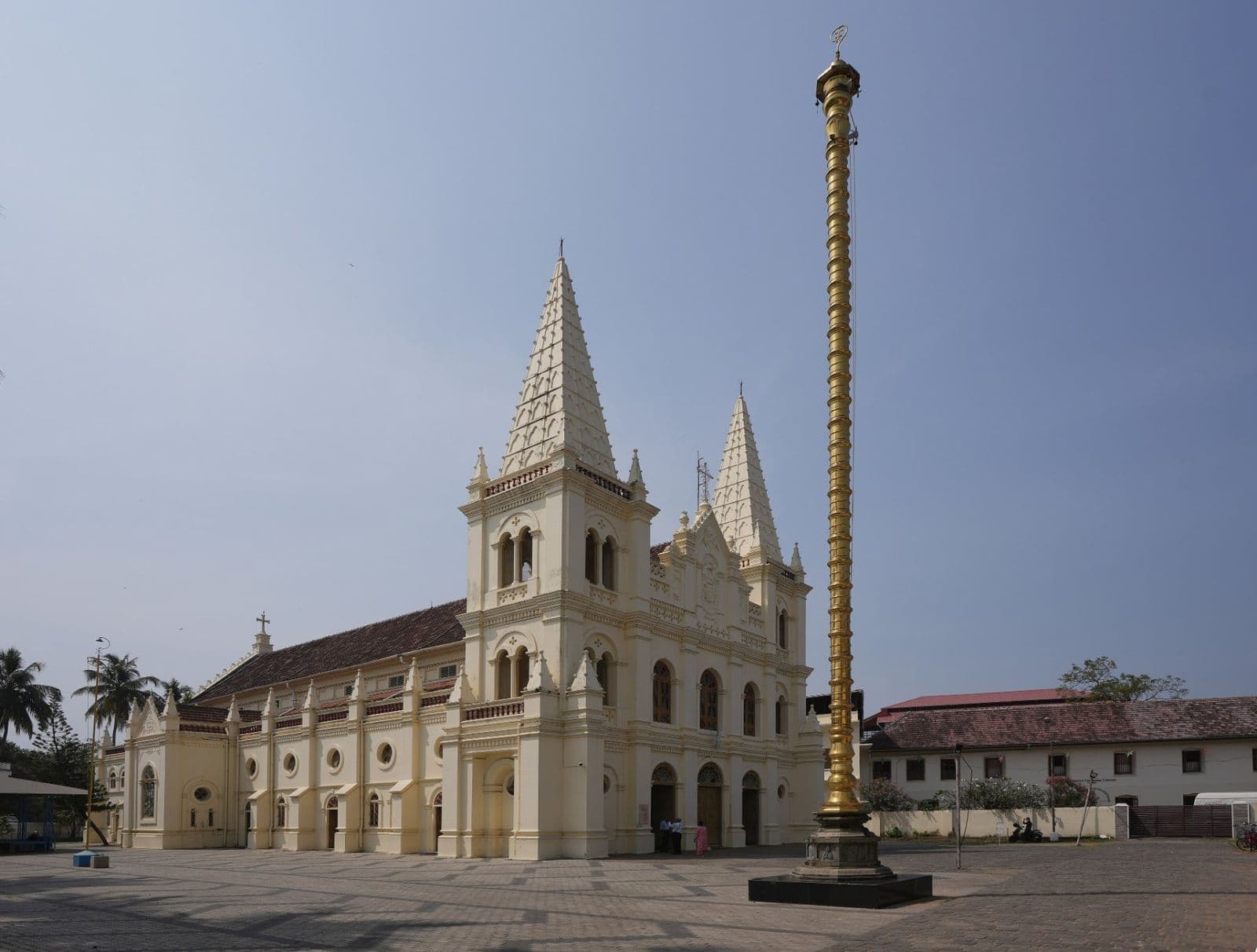
A Kerala Christian wedding takes place in church. After the vows, the groom ties the minnu, a small gold pendant usually marked with a cross, around the bride’s neck and drapes the manthrakodi, a blessed saree, over her. It is preceded by a betrothal (manasammatham) and a sweets ceremony (madhuram vekkal), and followed by a reception.
Kerala’s Christian traditions
Kerala has one of the oldest Christian communities in the world, with Catholic (Syro-Malabar, Syro-Malankara and Latin), Orthodox, Jacobite, Marthoma and Protestant churches. Wedding customs vary between churches and families, but several are widely shared.
Before the wedding
- Manasammatham. The betrothal, held in church, where the couple formally declare their consent to marry.
- Madhuram vekkal. Usually the day before the wedding, at the bride’s and groom’s homes: relatives feed the bride or groom sweets as a blessing, with singing and plenty of laughter.
The church ceremony
- Holy Mass or service, according to the church.
- Vows, exchanged before the priest.
- The minnu. The groom ties the minnu around the bride’s neck. In Syrian Christian tradition it often hangs on threads drawn from the manthrakodi.
- The manthrakodi. The groom drapes the blessed saree over the bride.
- Blessing and signing of the church register.
The reception
The reception follows at a hall or resort: a cake-cutting, speeches, music and a feast. Unlike a Hindu sadya, Christian wedding feasts often include meat and fish dishes, such as appam with stew or biriyani.
Planning tips
- Book the church early; the parish sets its own calendar and requirements, including marriage preparation courses.
- Most churches do not hold weddings during Lent.
- For destination weddings, many couples marry in a church near a resort and hold the reception by the water.
How it compares
| Aspect | Hindu | Christian | Muslim |
|---|---|---|---|
| The ceremony | The groom ties the thali around the bride’s neck at the muhurtham, the auspicious time | Vows in church, then the groom ties the minnu and drapes the manthrakodi over the bride | The nikah: a marriage contract agreed before an officiant and witnesses, with the mahr gift to the bride |
| Where | A temple, kalyana mandapam, family home or resort | A church, with the reception at a hall or resort | A mosque or family venue, with the reception after |
| Before the day | No days of rituals in most communities | Manasammatham (betrothal in church) and madhuram vekkal (sweets) | Mylanchi, the henna night, often with oppana songs |
| The feast | A vegetarian sadya on banana leaves | Often meat and fish, such as appam with stew, or biriyani | Malabar biriyani; the groom’s family hosts the walima |
| Usually avoided | The month of Karkidakam, in many families | Lent, in most churches | Ramadan |
Customs vary between communities and families. We also plan interfaith and fusion weddings and civil weddings under the Special Marriage Act.
Questions couples ask
What is minnu kettu?
The tying of the minnu, a small gold pendant usually marked with a cross, around the bride’s neck by the groom during a Kerala Christian wedding.
What is a manthrakodi?
A new saree blessed by the priest and draped over the bride by the groom during the church ceremony.
Can a Kerala Christian wedding be a destination wedding?
Yes. Couples marry in a church near the destination and hold the reception at a lakeside or beach resort.